Friday, 27 November 2015

Friday, 20 November 2015
Shooting Schedule
21st December, 1pm:
Going to train station to get some clips there before travelling to Bath to film time lapses.
6th January, 2pm:
Film powder paint shots in town.
7th January, 2pm:
Use the projectors at school to film the lip synching clips. We will project clips of powder paint, ink spilling, smoke, etc. to tie in with the appropriate lyrics.
Preparation:
Over the last couple of months, me and Nicole have both filmed snippets of things we have seen in our day-to-day life. These clips may be useful in bulking out our video in between narrative shots. Below is a YouTube video Nicole created, compiling a few of these clips.
Tuesday, 3 November 2015
Sunday, 1 November 2015
Who Is Involved?
Me and Nicole have decided that, as I filmed our Preliminary Task, I will also film our music video. We were both happy with the end result of that and I am experienced with the camera we will use. Over the past couple of months, we have both filmed short clips that we may use in our video to bulk it out between shots.
Nicole will be the only person to feature in our video for a couple of reasons. She also starred in our Preliminary Task and so is comfortable to be in our video. Also, by only using Nicole, organisation will be significantly easier as we will only need to make sure each other are free on the days of filming.
I edited both our AS video and our Preliminary Task. Because of this, I am likely to also be responsible for editing our music video as I am experienced with and confident in using this software. However, Nicole also knows the features of the software and so will be able to offer be creative and practical advice throughout the process.
When filming the powder paint scenes, we may require a few people to help us by throwing the powder. This would allow me to overlook the camera and make sure the shots come out well to avoid wasting time with shots that were out of focus, for example.
Saturday, 17 October 2015
My Digipak: Album Cover


For my front cover, I drew inspiration from the album's title, Badlands. I wanted there to be motifs throughout my work - from my music video to my poster and my album cover. I decided on using cities as a theme, tying in with the album title. These cities could be interpreted as the badlands. The image I used for my album cover was created with the help of my friend, Lauren, who is a photography student. We sourced images of city lights and projected them onto the model, Charlotte, who was dressed in a morph suit.
 |
| The original photo |
 The original images were very warm toned, with shades of reds and oranges. However, I wanted the colour scheme of my digipak to be representative of the artist's aesthetic. Halsey is incredibly well known for her turquoise and purple hairstyles and so I wanted to reflect this in my work. I used Photoshop when editing my images and utilised the layering tool to be able to alter some areas of my image. To start with, I opened up the hue/saturation tool to change the colour of my photo. I did this process twice, creating two different layers - one that had been tinted blue, and another that had been tinted purple. I then layered the two versions on top of eachother and used the erase tool to reveal the other colour underneath.
I then downloaded fonts to use on my digipak. To do this, I visited dafont.com, a website that offers free downloads for thousands of fonts. I wanted the artist's name to be prominent, whilst not too in your face. I used a bolder font, but placed it behind the model's head by using the erase tool to disguise it slightly. This technique is often used on magazine covers.
The album has a 'parental advisory' warning, so I downloaded an image of this sticker from google. I then placed it on the top corner of the cover so that it is visible, whilst not taking attention away from the image.
For the back cover, I wanted to reflect the artist's creativity and used a scanned image of watercolour paints. This image also tie in with the colour scheme I have set out for my work, as well as the artist's visual aesthetic. I used a simple font in white italics, and positioned them centrally on the back. Halsey's album served as an inspiration for this, as the back of it is very simplistic. I also included the artist's website, the record company and its logo, as well as copyright and licensing information. I also added a barcode to add to the realism of my product.

For the inside of my album, I continued the theme of projecting cityscapes onto faces. This time, I used Sophie and did not use the morph suit as I wanted her features to be visible. The original photos were quite bright in colour, so I desaturated these in order to make it more typical of the indie-pop genre. The image on the right is where the disk would be placed. For this image, I desaturated around Sophie but left the projection on her face quite bright. I also tinted some areas of the background purple, in order to tie in with the front and back covers. The same is true for the image on the left. I used the same technique as on the front cover to colour the image with areas of blue and purple.
Overall, I am very happy with my album cover. I believe it ties in well with the genre and that the use of cityscape projection links well with the album name.
Friday, 16 October 2015
My Digipak: Disc Design

As the images on my cover and inside the CD tray were quite busy, I opted for something much simpler for my disc design. The minimalism of the disc would also stand out from the bright images I have used. I decided on a light blue colour as this ties in with the colour scheme I have used throughout my digipak, as well as with the artist's personal style. To carry on the sense of continuity throughout my work, I used the same fonts as I did on my album and poster. After researching disc designs, I found what information is expected to be featured. This includes the artist name, the album name, the record label's logo as well as the copyright information. I decided to make the artist's name largest as this is typical of indie pop artists as they are developing themselves as a brand. The copyright information is contrastingly very small as it is a necessity rather than anything that particularly adds to the design. I have also featured an 'explicit' warning on the disc as this is something featured on the album. This, as well as the record label logo, has been coloured grey to match the colour scheme I had created.
Thursday, 15 October 2015
My Digipak - Album Poster

The picture I decided to use for my album poster is similar in style to that of my album cover. However, I wanted the colour scheme of my poster to be much more vibrant as a means of being eye catching. Album posters in general tend to be brightly coloured as this catches the attention of the public and thus generates interest for the album and, in turn, the artist. I wanted to impose a sense of uniformity across my media products in order to create brand recognition for the artist. The blue tones of the image on my poster tie in with the filter I would like to use when editing my music video. I also decided to use a cityscape projection to mirror the images used on my album cover whilst also linking in with the album title "Badlands."
I have kept the poster relatively simple, only including information I believe to be important. The album name is the predominant feature of the poster, followed by the artist name. This was deliberate as the purpose of the poster is to promote. Another key feature of the poster is the album release date. This generates excitement and anticipation for the album, setting it up for much greater success. The recent surge of digital media has meant that artists need to utilise platforms such as iTunes and Spotify to evolve in today's society. Because of this, I wanted to mention that the album would be available on both of these and positioned it near the top of the poster. I also included the Apple logo - a logo which is instantaneously recognised by millions. My chosen artist, Halsey, gained recognition through social media and so I thought it was imperative to make it available on these platforms. This is also typical of indie artists as their main priority is getting their music heard, rather than gaining a profit.
Wednesday, 30 September 2015
Intertextuality
John Stuart suggested the idea of intertextuality, describing it as "incorporating, raiding and reconstruction." Music videos use something with which the audience may be already familiar with to generate both nostalgic associations and new meanings. Intertextuality is perhaps more explicitly evident in music videos than any other media form, with the possible exception of advertising.
Goodwin's theory also mentions intertextuality, stating that intertextual references add to the post modernism of music videos.
Examples of videos that parody other media include Madonna's Material Girl and Iggy Azalea's Fancy as they borrow ideas from iconic films.
Goodwin's theory also mentions intertextuality, stating that intertextual references add to the post modernism of music videos.
Examples of videos that parody other media include Madonna's Material Girl and Iggy Azalea's Fancy as they borrow ideas from iconic films.
 |
| Gentlemen Prefer Blondes |
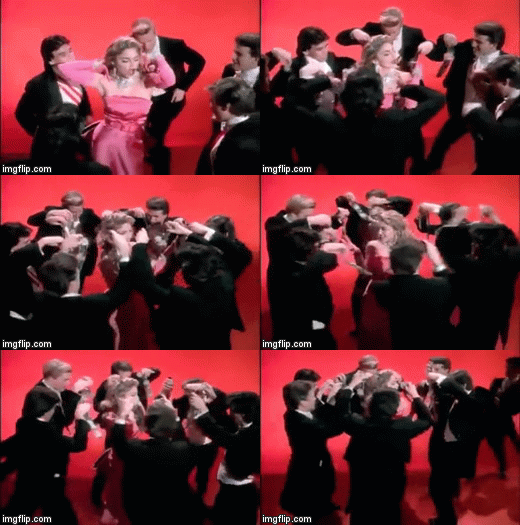 |
| Madonna - Material Girl |
 |
Clueless
|
 |
| Iggy Azalea - Fancy |
While these videos reference films, there are many that mirror other music videos. An example of this would be Shania Twain's Man! I Feel Like A Woman as it follows the style of Robert Palmer's Addicted to Love.
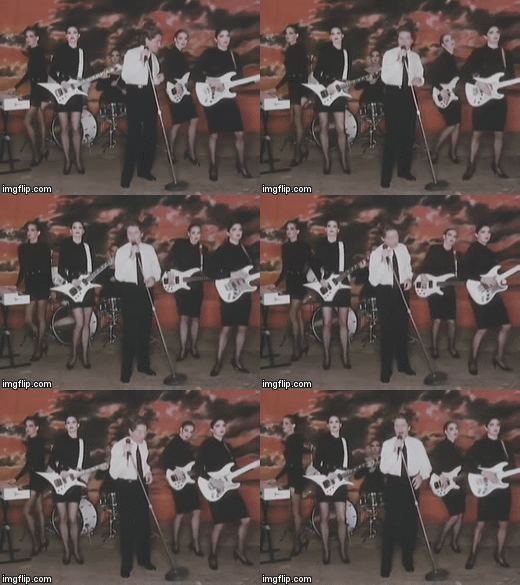 |
| Robert Palmer - Addicted to Love |
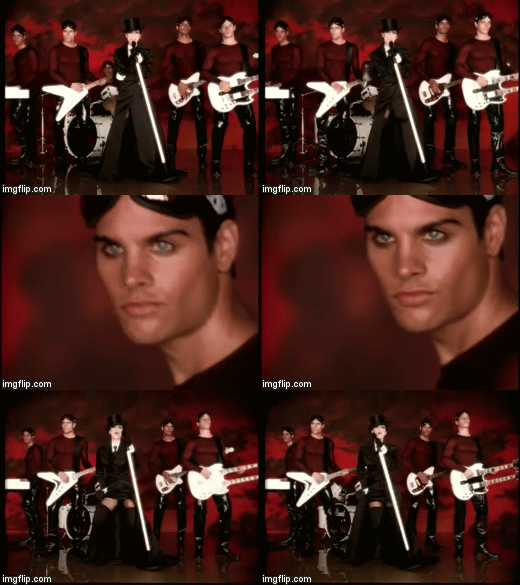 |
| Shania Twain - Man! I Feel Like A Woman |
I will not be using intertextuality in my music video as it is not typical of my chosen genre.
Friday, 25 September 2015
Andrew Goodwin's Theory
Do you agree with Andrew Goodwin's comment that music videos demonstrate genre characteristics?
I believe Goodwin's comment is applicable to the majority of music videos in the current market. Whilst looking into different music genres, the characteristics Goodwin noted became prominent in my research. Pop music videos proved to follow Goodwin's findings as it is not uncommon for groups to include dance routines and a bright colour palette. An ex ample of this is the video for Fifth Harmony's 'Worth It' as it perfectly embodies these characteristics. Likewise, videos within the rock genre typically conformed to performance style videos with darker colour schemes. While these videos do demonstrate the characteristics noted in Goodwin's theory, there are many music videos that do not.
Paramore's music has been described as alternative rock and pop rock, however their music video for 'Ain't It Fun' challenges the stereotypes set out for these genres. Goodwin found that music videos falling in the rock genre typically favour performance style videos. In contrast, the video for 'Ain't It Fun' could be described as concept as the band set out to break multiple world records. The female lead occasionally lip-synchs the lyrics of the song as opposed to the band performing. This is atypical of the rock genre and instead complies with the conventions of the pop genre. The colour scheme also differs from those of rock videos in Goodwin's theory; a bright, colourful palette is used as opposed to the darker tones Goodwin suggests.
Paramore's music has been described as alternative rock and pop rock, however their music video for 'Ain't It Fun' challenges the stereotypes set out for these genres. Goodwin found that music videos falling in the rock genre typically favour performance style videos. In contrast, the video for 'Ain't It Fun' could be described as concept as the band set out to break multiple world records. The female lead occasionally lip-synchs the lyrics of the song as opposed to the band performing. This is atypical of the rock genre and instead complies with the conventions of the pop genre. The colour scheme also differs from those of rock videos in Goodwin's theory; a bright, colourful palette is used as opposed to the darker tones Goodwin suggests.
 |
| Pop Conventions: Lip-synching |
 |
| Pop Conventions: Bright colours |
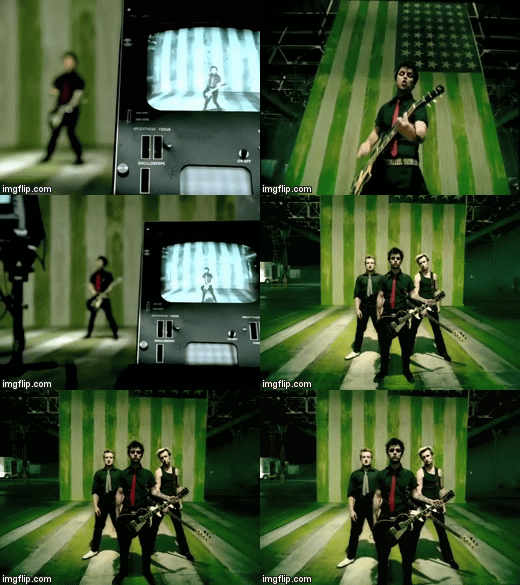
However, Green Day's 'American Idiot' exemplifies Goodwin's genre characteristics. The lighting is very dark, along with the clothing of the band members. The video is labelled as 'performance', something typical of the rock genre. Similarly, the lighting is very dark, along with the clothing of the band members.
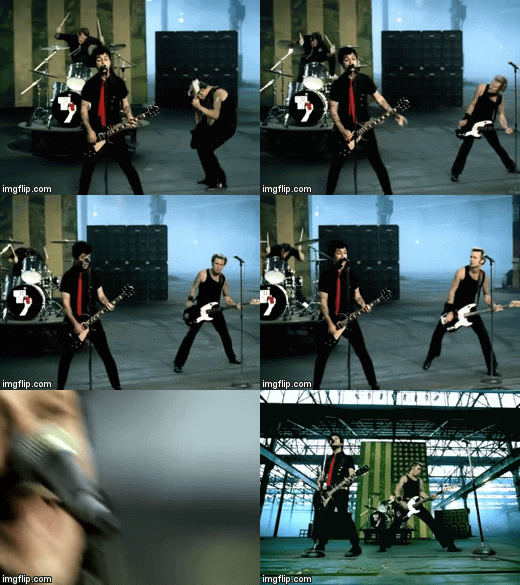
To conclude, I do agree that music videos demonstrate genre characteristics as, throughout my research, I have found that many videos follow Goodwin's theory.
Sunday, 13 September 2015
Saturday, 12 September 2015
Friday, 11 September 2015
Target Audience
 I have decided that my target audience will be people aged 16-20 as this is the typical demographic of indie-pop music. While my music video will appeal to both genders, it is likely to be preferred by females, as my chosen artist has a very female-dominated fanbase. This ties in with the outcomes of my audience survey, as this revealed that over 70% of respondents were female. My target audience are likely to be students, which is also backed up by the results of my audience research survey.
 After googling "Halsey with fans", it became evident that the majority of her fanbase are young and female. This supports my decision to target my music video at a predominantly female audience, aged 16-20. The largest proportion of respondents were also aged 16-20 years old, meaning I have reliable information on the interests and opinions of this demographic. I also fit into this demographic, allowing me to have a deeper understanding of what this group would look for in a music video.
I used Polyvore to create a visualisation of how a typical indie-pop music fan may dress. The clothing styles are unlike mainstream fashion, taking inspiration from previous decades including the 80s and 90s.


I also created this magazine cover mock up to further demonstrate media forms that would appeal to my target audience. I decided to use Halsey on the front cover as she is an artist who is currently of prominence in the indie-pop scene. The feedback I received from my audience research revealed that most people watch music videos if they are a fan of the artist. I also included other indie-pop artists who are featured in the magazine. This emphasises the idea that it is aimed at people who like this genre of music and thus would encourage them to read and buy this magazine.


Music Video Pitch
Me and Nicole created this Prezi to outline our plan for our music video. We then presented this to our peers and received feedback on our ideas. During this activity, we also watched the pitches of others in our group. This allowed us to gain inspiration and develop our ideas further.
Thursday, 10 September 2015
Outcomes of Audience Research
Having created and shared my questionnaire, I decided to collate my data. I used meta-chart.com to interpret my data into pie charts, making it much easier to analyse.


Gender

The majority (71.8%) of my respondents were female, which is also representative of the artist's fan base. The proportion of male audience members is too large to ignore, so I will ensure my music video appeals to both genders. Having a female lead in our music video is a subtle way of appealing to the female majority.

Age
The most common age range of the audience was 16-20 years old. This is very similar to both my planned target audience and the artist's fan base.
I also fall into this age range and thus have an idea of what people my age like. With this knowledge, I should be able to ensure my video appeals to this age range.
 Occupation

77% of respondents were students, meaning they are unlikely to have a disposable income. With this in mind, I will ensure my music video is not overly-produced as to make it realistic for the audience. This also ties in with the genre characteristics of an indie-pop music video.

Preferences

My research found that most people watch music videos if they're a fan of the artist. This correlates well with my other findings as they match the profile of a typical Halsey fan.
Other factors my respondents listed as being important when deciding whether to watch a music video include it being good quality and interesting.
Likewise, I asked what they did not like in music videos. This was an important part of my research as it guided me with things not to include. Below are some of these answers. Those in bold are answers that were mentioned most frequently.
- If the women are overly sexualised
- Cliché love story
- Dance routines
- If it is too long
- Irrelevance to the song
- Poor quality
- If they are boring
The indie-pop genre does not often sexualise women and our video will not be an exception. If we did decide to include this, while having a predominantly female audience, we would risk making our viewers feel objectified and uncomfortable.
Our video will be shot with high quality cameras to ensure we maintain a sense of professionalism, while straying away from an over-produced feel. We will shoot our video in regular settings, such as on trains and in streets, to achieve this.
We plan to use elements of the song in our music video as this will maintain its relevance and the interest of viewers. To do this, we can look at the lyrics of the song and think of creative and original ways to present them.
Tuesday, 8 September 2015
Monday, 7 September 2015
Music Industry Research
Who are the main television companies that show music videos?
MTV
 MTV is, arguably, the most well known television companies that broadcasts music videos. Created by the Viacom Music and Entertainment group, it first aired in 1981. The channel's niche was that it exhibited music videos 24 hours a day. While MTV is still of prominence, it now also produces and broadcasts its own television shows. It does, however, have spin-off channels (including MTV Hits) that have stayed with the channel's original promise. Through the decades, MTV has actively promoted the careers of influential artists such as Madonna, Michael Jackson and Nirvana.
As the influence of television evolved, so did MTV. It has since expanded into a group of genre-specific subsidiaries, while the original channel has shifted to showing reality programmes target at a younger audience, such as Catfish and Geordie Shore. Channels such as MTV Rocks, however, still remain true to the channel's initial niche. Here, they broadcast music videos, award shows, artist interviews and live performances.
VH1
 Another popular television channel known for showing music videos is VH1. It was also a part of the Viacom Music and Entertainment group, created in order to try and build on the success of MTV. They began by airing 'History of Music Videos', where they would show a large proportion of their music video library. To avoid competition between audiences, VH1 aimed their content at a slightly older audience by focussing on the softer side of the pop music spectrum.
Similarly to MTV, VH1 also has additional genre-specific channels, including VH1 Classic and VH1 Soul. This continued to appeal to their older audience and thus did not detract from MTV's success.
CSC Media Group

 CSC Media Group are a UK-based satellite television channel provider. Some of the UK's most popular and accessible music video channels (including Scuzz, Starz TV, The Vault and Chart Show TV) belong to this group. These channels cover a range of music genres and thus cater to a much larger audience. They are also available on Freeview, unlike MTV, which also allows a greater audience to access their channels. However, it also means that the group lacks production budget and instead make money through encouraging audiences to text in their requests.
Where can you find music videos?

 The most popular platforms for music videos are YouTube and Vevo, although they can now be found virtually anywhere. These two platforms are the platforms artists use to premiere their music videos, making them reputable sources. However, the influence of social media has meant that anybody can share and embed videos on a multitude of platforms - from Twitter and Facebook, to blogs and websites.
 What is the purpose of music videos?
Generally, music videos were meant to promote the artist and the sale of music recordings. They are used to promote a single, which, in turn, promotes an album and finally the artist. It is a viable marketing technique and also means labels do not always have to spend a lot of money in doing so. As music videos have become a widely recognised media platform, the reasons for producing them have shifted slightly. For example, music videos are now also being used to promote films - such as Halsey's video for her song Castle. However, generating money for the record company and gaining recognition for the artist remains the main reason for producing music videos.
My music video
My music video would be likely to be distributed through both music television and Internet platforms such as YouTube and Vevo. These are the most popular sites for artists to premier their music videos, as well as reputable and easily accessible. I will be uploading my video to YouTube as this is the biggest video sharing platform on the Internet. If it was a real world media product, the artist would likely release the video on both YouTube and Vevo. My music video would appear on television channels like those previously mentioned, including MTV Music and Chart Show TV. Having researched these channels, I know the style of music played on them and, most importantly, their target audiences. I believe the style and audience of my chosen song suits these platforms well and thus would be successful.
Saturday, 5 September 2015
Music Video Inspirations
After having looked into the lyrics of my chosen song (see here), I had some ideas of themes and motifs I wanted to include in our video. The use of colour in the song gave me the idea of including some sort of paint to tie in with Goodwin's theory of the link between visuals and lyrics. I found some music videos that have also used a similar idea. Including a take on this conceptual element in my video would work well as it follows genre traits as well as linking in with the song's lyrics.
Foxes - Let's Go For Tonight



Paramore - Now


Thirty Seconds To Mars - Up In The Air


I especially like that these videos all have a pretty neutral colour scheme before the introduction of the bright paints. I think this would work well in my music video as muted colour palettes are typical of the indie-pop genre. This theme especially fits with the song's title ('Colors') and its lyrics.
.
Zayn - Pillow Talk


Subscribe to:
Posts (Atom)